
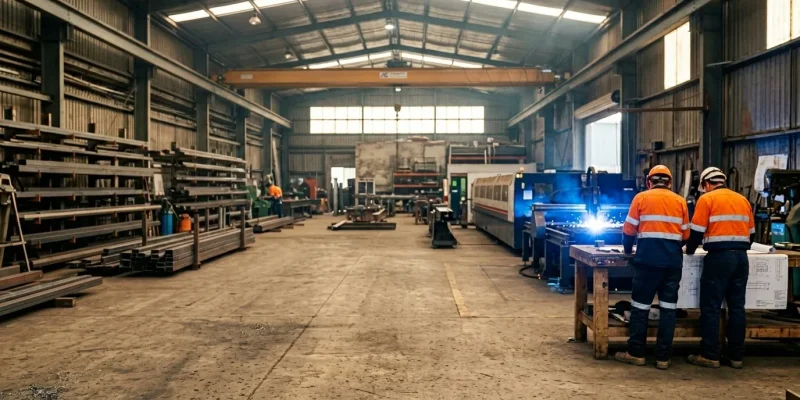
Why This Matters Before You Sign the Fabricator Contract
Most builders treat steel fabrication QA as the fabricator’s problem. Wrong frame. AS/NZS 5131 — the execution standard for structural steelwork in Australia and New Zealand — sorts every steel job into a Construction Category. That category dictates welder qualifications, documentation depth, NDT (non-destructive testing) coverage, and traceability. Get it wrong on paper, get it wrong in the shop, and the consequences land on you: blocked occupancy sign-off, voided builder warranty insurance, rejected client handover.
This article cuts through the standard. Four categories, what determines yours, where builders get it wrong, and a pre-contract checklist that keeps your project clean.
1. The Four Categories in Plain English
AS/NZS 5131 defines four Construction Categories. Many older summaries online only mention three — that is outdated or incomplete. The standard explicitly recognises CC4 for unusual or non-conventional structures.
- CC1 (Construction Category 1) — lowest risk. Single-storey domestic sheds, fence posts, simple agricultural shelters, low-consequence structures. Minimum QA documentation.
- CC2 (Construction Category 2) — moderate risk. Multi-storey townhouses, custom homes, mid-rise commercial, standard industrial portal frames, mezzanines, schools. Roughly 90% of Australian structural steel projects sit here.
- CC3 (Construction Category 3) — high risk. High-rise commercial, multi-storey residential (typically 6+ storeys), hospitals, large public buildings, long-span industrial structures with heavy dynamic loads. Strict QA, full traceability, third-party inspection.
- CC4 (Construction Category 4) — highest risk. Special or unconventional structures where consequences of failure are extreme, or where execution requirements exceed CC3. Bridges of high importance, critical infrastructure, signature public structures. Requirements are project-specific — defined case-by-case by the engineer of record, beyond the baseline tables in the standard.
Your project is almost certainly CC2. The question is whether your fabricator can actually deliver CC2 documentation — or whether you discover at handover that the paperwork falls short.
2. What Determines Your Project’s CC Level
The Construction Category is not chosen by the fabricator and not chosen by you. It is determined by the project’s structural engineer (RPEng) during structural design, based on a risk matrix combining three input variables defined in AS/NZS 5131:
- Importance Level — consequence of structural failure. Loss of life, property damage, public impact. Set per the National Construction Code (NCC) and AS/NZS 1170.0. A standalone shed and a 200-bed hospital are not the same conversation.
- Service Category — the nature of loads the structure carries. SC1 = predominantly static or quasi-static loading (most buildings). SC2 = fatigue loading, seismic action, dynamic loads (cranes, bridges, vibrating equipment).
- Fabrication Category — execution complexity and weld criticality. PC1 = simpler fabrication, lower-strength steels, less critical welds. PC2 = higher-strength steels, complex welded connections, hot-formed hollow sections in critical joints.
These three inputs feed a matrix in AS/NZS 5131 Section 3 that produces the Construction Category. The structural engineer documents the result on the structural drawings or in the project specification. It belongs in your contract with the fabricator. If it isn’t in the contract, raise it before signing.
Quick examples:
- 6-unit townhouse, static loads, standard welds → CC2
- Single-storey commercial warehouse, 15m portal frame → CC2
- 10-storey office building → CC3
- Hospital, multi-storey school → CC3
- Heavy-duty crane runway beam, repeated dynamic loading → CC3 or CC4 depending on Importance Level
- Major bridge, signature public infrastructure → CC4
3. CC1 — When You Really Have a CC1 Project
Genuine CC1 territory:
- Single-storey shed under ~100 m²
- Simple domestic garage, freestanding carport
- Agricultural shelter, light farm structure
- Small portal frame, short span, static load only, low Importance Level
QA requirements at CC1:
- Mill certificates for all structural sections (no Construction Category waives this — every project needs traceable material)
- Welder qualifications relaxed but still required to AS/NZS 1554.1
- NDT not mandated as routine; visual inspection typically sufficient
- Basic production drawings and minimal documentation pack
The trap: builders and small fabricators assume “small project = CC1” and skip CC2 documentation. When the RPEng arrives for sign-off and the project is actually CC2 (because it carries an Importance Level 2 designation, or because a mezzanine added dynamic loading), the paperwork doesn’t exist. You either redo work, pay rush fees to retrofit documentation, or fail occupancy.
Rule of thumb: if you’re not certain you have a CC1 project, you don’t. Build to CC2.
4. CC2 — The 90% Default (And Where Things Get Tricky)
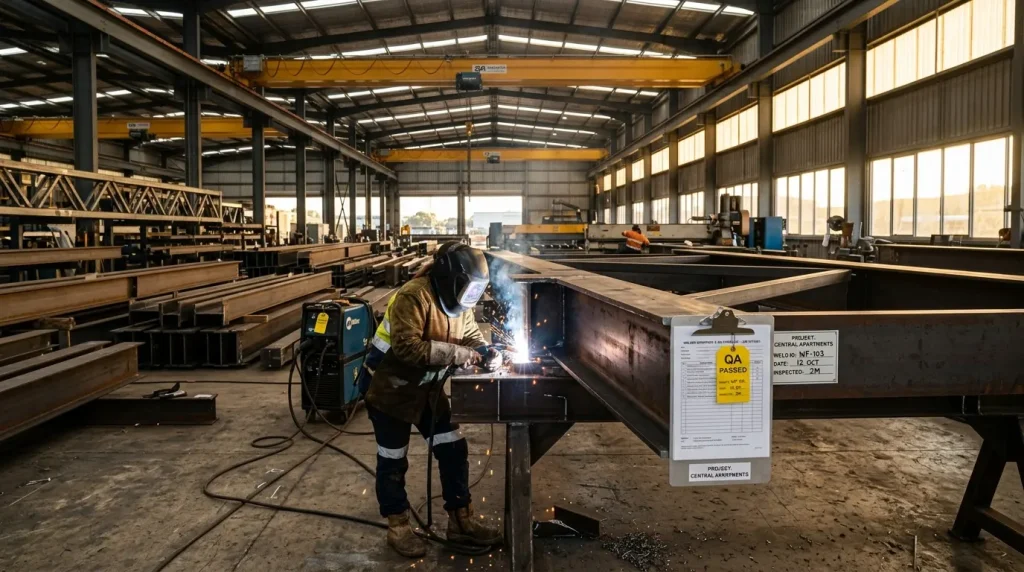
Typical CC2 territory:
- Multi-storey townhouse developments
- Custom homes with structural steel beams and columns
- 2–5 storey commercial offices
- Mid-size industrial portal frames
- Mezzanine platforms in warehouses and retail
- School and early-learning centre extensions
- Most aged-care, retail, and hospitality fit-outs
QA requirements at CC2:
- Welder qualifications to AS/NZS 1554.1, current and verifiable
- Welding Procedure Specifications (WPS) and Procedure Qualification Records (PQR) for the welds being performed
- NDT on a defined sample basis — critical joints typically 100% inspected; non-critical joints by random sample, per the Inspection and Test Plan (ITP). Exact coverage percentages depend on weld type, joint criticality, and the combination of Service Category and Fabrication Category — CC3 is not blanket “100% NDT” and CC2 is not “no NDT”. The ITP is the controlling document.
- Mill certificates, full material traceability, production drawings
- Fabricator declaration of conformity at handover
A compliant fabricator builds this documentation pack as a matter of course on every CC2 job. “Finding a compliant fabricator” means finding one whose default output matches CC2 requirements — not one who scrambles to assemble paperwork after the fact.
Insurance angle: when a claim is investigated under builder warranty or construction insurance, the assessor will request fabrication QA documentation. CC2 project with missing WPS, expired welder tickets, or no NDT records = grounds for the insurer to dispute the claim. The documentation is not bureaucratic theatre. It is the evidence trail that protects you when something goes wrong.
5. CC3 — When You Need More
CC3 territory:
- High-rise commercial, multi-storey residential (commonly 6+ storeys)
- Hospitals, major public buildings
- Long-span industrial structures (30m+ portal frames) with heavy loads
- Crane runway beams with repeated dynamic loading
- Structures with high Importance Level and complex welded connections
QA requirements (in addition to CC2):
- NDT coverage scaled up significantly — for many critical welds, 100% inspection becomes the requirement, but the specific percentages still come from the project ITP and the standard’s tables, not a single blanket figure
- Higher-tier welder qualifications and project-specific weld procedure qualification
- Independent third-party inspection during fabrication
- Full traceability — every section traced from mill heat number through fabrication batch to final installed location
- Fabricator capability audit before contract award — not every shop can deliver CC3
Practical impact on the builder: CC3 projects need fabricators with demonstrated CC3 capability — staff qualifications, NDT relationships, audit history, QA management systems. Engage the fabricator early. Mid-project discovery that your fabricator can’t deliver CC3 documentation is a serious delay event.
6. CC4 — The Outlier Category
CC4 is rare in standard commercial building work. Reserved for:
- Structures of exceptional Importance Level
- Major bridges, critical infrastructure
- Unusual configurations where failure consequences are extreme
- Projects where requirements exceed what the AS/NZS 5131 tables prescribe for CC3
For CC4, requirements are defined project-by-project by the engineer of record, in a project-specific execution specification. Documentation, inspection regimes, fabricator pre-qualification, and witness points are all set above CC3 baselines.
If your project is CC4, you already know — it comes with a dedicated execution specification, named consultants, and a procurement process that vets fabricators well before tender.
7. Common Mistakes — Where Builders Get the CC Wrong
- Mistake 1: Pricing the job as CC1 when the engineer’s drawings call CC2. Fabricator either undercuts QA to hit the price, or invoices a variation mid-project to retrofit documentation.
- Mistake 2: CC2 project with welders whose AS/NZS 1554.1 qualifications expired mid-fabrication. Welds done outside qualification window can be rejected at sign-off.
- Mistake 3: CC3 project awarded to a CC2-capable fabricator on price. Third-party inspection and traceability requirements cannot be reconstructed retroactively.
- Mistake 4: Insurance claim denied because fabrication QA pack is incomplete. The cheap fabricator saved you $8k; the claim dispute costs you $400k.
- Mistake 5: Cross-border projects. A Victorian-fabricated structure installed in NSW still needs documentation that satisfies the relevant building authority and certifier. Not every fabricator runs a documentation system that travels.
8. The Builder’s Pre-Contract Checklist
- Confirm the CC level with the structural engineer in writing. It belongs on the structural drawings or in the specification. Don’t accept “probably CC2.”
- Ask the fabricator’s CC capability directly. Welder qualifications current? WPS/PQR library covering the welds on your job? NDT subcontractor relationships? CC3-capable if needed?
- Specify the documentation pack in the contract. Mill certs, welder qualifications, WPS and PQR, NDT reports, ITP, declaration of conformity. Spell it out so there is no debate at handover.
- Schedule site visits during fabrication. QA is a process, not a final-day audit. Visiting the shop mid-fabrication catches problems while they are still cheap to fix.
- Demand the full ITP summary at completion. The RPEng needs this for sign-off. The certifier needs this for occupancy. Your insurer needs this if anything goes wrong later.
An integrated fabricator — in-house CAD, qualified welders, established NDT relationships, single point of accountability for the documentation chain — collapses three or four coordination interfaces into one. A.C. Steel operates this way: detailing through fabrication through install under one roof, with the QA pack assembled as part of normal workflow rather than scrambled together at handover.
Bottom Line
CC1, CC2, CC3, CC4 are not internal fabricator jargon. They are the compliance backbone that determines whether your project gets occupancy sign-off, whether your builder warranty holds up under a claim, and whether your client moves in on schedule. Around 90% of projects sit at CC2 — the real question is whether the fabricator you’ve engaged delivers genuine CC2 documentation by default, or assembles it after the fact (or not at all).
For mezzanines, portal frames, multi-storey custom homes, and any project where the engineer has nominated CC2 or above: engage a fabricator with in-house detailing, current welder qualifications, and a working QA system from the first quote. One layer of project risk eliminated before the steel is ordered.